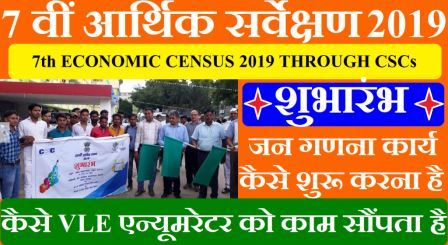
7th Economic Census lunched in Uttar Pradesh To Day by CM
Subject: Vision document for conduct of the 7th Economic Census (EC), 2019
1. Introduction
1.1 The non‐farm economic activities carried out in India have lot of diversity in terms of
organization and management. They are carried out by units registered /licensed under
various laws and regulations or by self‐employed/ own account establishments not
registered/licensed. Some of them operate in fixed visible premises/ location or at different
premises/ location and some operate within household categorized as invisible units.
Some units operate only to serve other unit(s). Some operate seasonally or casually and
some may not operate throughout a given year. They are engaged in different economic
activities, relating to primary, secondary and tertiary sector. Some of them may engage
themselves in multiple economic activities at any given point of time and some may
diversify their activities from time to time.
1.2 With so much diversity, the units engaged in non‐farm economic activities, if measured
properly, will give indications about location‐wise economic activities, occupations,
employment and relatively inactive locations in terms of the characteristics measured.
1.3 Conducting periodic Economic Census has been the means of measuring the diversity of
non‐farm economic activities in all its major dimensions. In respect of units operating in
fixed premises/ locations, the Economic Census is expected to provide updates on units
actually operative to the concerned registering /licensing authorities, most of whom have
no mechanism to maintain live registers. In respect of units without fixed premises /location
and invisible units, the Economic Census is expected to provide location‐wise information
on number of units along with other characteristics. The census also provides information
Page 2 of 19
on clustering of various economic activities/ occupations at different locations and on lack
of adequate involvement in such avocations in some locations. Comparing the information
provided by two consecutive Economic Censuses will throw light on locations becoming
more and more economically active, location that are not so, and on emerging activities/
occupations, and those that are waning away over time. All this information is very
important for policymakers in the government at all levels for evolving policy interventions.
1.4 For the statistical system at National and sub‐national level, Economic Census has been very
important national statistical program in which the center and all the States/
UTs simultaneously participate with a common goal.
1.5 Statistical measurement of non‐farm sector requires differential treatment in coverage of
units both larger and smaller in size. Larger units will be organized into a dynamic register,
known as ‘Business Register’. The other components (unorganized or informal sector) will
be organized into location‐wise information, to be used as frame for conducting periodic
sample surveys for further studies.
1.6 The information collected through Economic Census, and the follow up surveys using these
Business Registers and the frame will be useful for measuring performance of the sectors
and its sub‐sectors d for compilation of quarterly/annual national/sub‐national accounts.
2. Economic Censuses conducted in the past
2.1 The First Economic Census was conducted throughout the country, except Lakshadweep,
during 1977 in collaboration with the States/ Union Territories (UTs). The coverage was
restricted to only non‐agricultural establishments employing at least one hired worker on a
fairly regular basis. Data on items such as description of activity, number of persons usually
working, type of ownership, etc. were collected.
2.2 The subsequent Censuses were conducted in the years 1980, 1990, 1998, 2005. The 6th and
the latest census was conducted in 2013. These Censuses were conducted in collaboration
with the States/ UTs. The report of the 6th Economic Census is available on MoSPI website.
Census‐wise growth rates in Establishments and Employment is presented in Table 1 of
Page 3 of 19
Annex I. Further, distribution of agricultural and non‐agricultural establishments by size
class of employment of the establishments and broad activity wise total number and
percentage of persons employed in establishments with 8 or more persons employed sector
wise in the 6th Economic Census are presented in Tables 2 and 3 respectively at Annex I.
3. Salient features of the Sixth Economic Census (2013)
3.1 The Sixth Economic Census was conducted in all the States/UTs. All economic activities
(agricultural and non‐agricultural), except those involved in crop production and plantation,
public administration, defense and compulsory social security, related to production and/or
distribution of goods and/or services other than for the sole purpose of own consumption
were covered. However, the following activities were kept out of the purview of the Sixth
EC:
(a) Establishments of shelter‐less and nomadic population, which keep on moving from
place to place and camp either without shelter or with makeshift shelter.
(b) Establishments engaged in illegal activities like smuggling, gambling, beggary,
prostitution, etc.
(c) Domestic servants, whether they work in one household or in a number of
households, drivers, etc. who undertake jobs for others on wages.
(d) All wage‐paid employees of casual nature.
(e) Household members engaged in household chores.
(f) Persons doing different types of jobs depending on the availability of work e.g.
loading, unloading, helping a mason or a carpenter, doing earthwork for a contractor.
(g) Household members working for other households and earning some money which is
insignificant.
(h) Households in which none of the members is engaged in any gainful activity i.e.
Blocks facilitates linking of Population Census database with that of Economic Census
database at the lower geographical levels such as wards and villages.
3.3 About 8.5 lakh enumerators and 3.2 lakh supervisors were deployed to collect information.
For listing purposes, all houses/ households/establishments were visited. The field work was
done under the statutory provisions of the Collection of Statistics Act, 2008 and Rules made
thereunder.
3.4 Challenges faced during conduct of 6th EC:
3.4.1 Data collection for the 6th EC was carried out over a period of 1 year 2 months in the
country. This resulted in reference period varying across different locations in the country.
3.4.2 The fieldwork was assigned in some State/ UTs to persons like Anganwadi workers, Gram
sevaks, Panchayat secretaries, Unemployed Youth, NGO Workers, etc. who were handling
the data collection exercise for the first time.
3.4.4 It took 3 years 6 months to bring out the final report of the 6th EC after its launch in January
2013 due to manual intervention in generation of the reports
3.4.5 Business Register could not be prepared by some States .
4 Need for 7th Economic Census
4.1 The Government had appointed a Task Force on Improving Employment Data in May, 2017,
under the Chairpersonship of Vice Chairman, NITI Aayog to suggest ways and means of
improving employment data. The Task Force made various recommendations in its report
submitted in August, 2017, including that the Ministry of Statistics and Programme
Implementation may undertake the Economic Census every 3 years, beginning with the 7th
Economic Census so that more frequent information on the various economic
characteristics of establishments are available and could be compared with the existing
databases in the GSTN, EPFO, MCA etc.
4.2 Accordingly, the 7th Economic Census has been conceived to provide:
Page 5 of 19
(i) A nation‐wide Business Register as per international practices adopted by
developing countries and in line with UNSD recommendations.
(ii) Detailed information on economic variables, activity wise, of all the non‐
agricultural establishments of the country including its distribution at all India,
State, district, village/ward levels for comprehensive analysis of the structure of
the economy;
(iii) Information on establishments registered under MSME Development Act, their
assets and other economic criteria;
(iv) Information on number of workers working in establishments (which are under
operation), activity wise and area wise on;
(v) List of all establishments, tagged by geographical location up to village/ward level
for local level planning purposes;
5. Scope and coverage proposed for 7th Economic Census:
5.1 All households/ establishments engaged in non‐agricultural economic activities including
construction, except public administration, defense and compulsory social security are
proposed to be covered in the 7th Economic Census. Once the model of conduct of the 7th
EC stabilizes, the scope can be enhanced to include these sectors from the 8th Census
onwards.
5.2 All households and establishments are proposed to be covered in the 7th Economic Census.
Enumeration blocks of Population Census 2011 will form the primary geographical unit. Out
of these.
5.3
One of the main aims of the Economic Census is preparation of a National Business Register
which can be linked with existing databases at the central and state government levels. It is
also proposed to have in place a threshold turnover in monetary terms for such
households/ establishments for inclusion in the coverage of the Census.
5.4 Establishments with fixed structures are proposed to be covered at the place of their
operation. On the other hand, economic activities that are carried out without any fixed
Page 6 of 19
structures are proposed to be covered at the place of the residence of the owner. All types
of establishments (perennial, seasonal and casual), existing on the date of census, although
may not be in operation on the day due to certain reasons, are also proposed to be covered
in the census.
5.5 The parameters for which data is proposed to l be collected in 7th Economic Census is at
Annex III.
6. Business Register
6.1 The Business Register was originally conceptualized for collating the list of all registered
establishments pursuing various economic activities relating to production of goods &
services.
6.2 The 13th Finance Commission recommended development of Business Registers at District
level so that it can be used for estimating District Domestic Product. The Business Register
developed by few of the States/ UTs with the funds provided by the 13th Finance
Commission is primarily an accumulation of establishments registered under the following
Acts and registering authorities:
(i) Companies Act, 1956
(ii) Factories Act, 1948
(iii) Shops and Commercial Establishments Act
(iv) Societies Registration Act
(v) Cooperative Societies Act
(vi) Khadi and Village Industries Board
(vii) Directorate of Industries (District Industries Centre)
6.3 Some of the States/ UTs have taken proactive measures to include establishments
registered under Acts other than the ones mentioned above for defining the scope of their
State Business Register. The States/ UTs were advised to produce a 16‐digit location code
(BRN) for a business establishment in the register with the help of Census codes.
Page 7 of 19
6.4 The activity has been taken up on piecemeal basis and even after a long time has elapsed
since the funds were provided under 13th Finance Commission, most of the State/ UTs are
not in a position to come up with their Business Registers.
6.5 In this regard, for development of a dynamic Business Register during the 7th Economic
Census, the following measures are proposed:
(i) Create and maintain an online portal at the national level that will periodically get
updated with the State databases where available and those States not having
digital databases may use the national database for regular updation through
standard processes. Feasibility of providing funds from SSSP project of MoSPI for this
purpose may be explored.
(ii) The National Business Register will establish dynamic linkages, using API/Web
Services with the existing national databases for 6thEconomic Census, Annual Survey
of Industries, MCA‐21, GST, EPFO, ESIC, Udyog Aadhar (MSME) and list of
establishments maintained under State Registering authorities.
(iii) As a prelude to the Economic Census, the de‐duplicating of these databases will be
done using Big Data Analytics and cross validated with the field work of Economic
Census and geo‐tagging of the establishments. The National Business Register
system is proposed to generate a unique Business Registration Number (BRN) for
each establishment.
(iv) Nominate nodal officers at the Central and State level for ensuring regular updation
and maintenance of this database and coordinating with MoSPI for the National
Business Register.
(v) An Inter‐ministerial coordination mechanism will be established for smooth conduct
of the Economic Census activity as envisaged above. Frequent stakeholder
consultation in this regard will also be undertaken. For undertaking the Economic
Page 8 of 19
Census, the statutory provisions of the Collection of Statistics Act, 2008 may l be
leveraged for achieving the desired results.
7. Reference period and field work:
7.1 Reference period for items of information would more or less correspond to the survey
period only as information on the operational parameters, such as type of industrial activity;
type of ownership; nature of economic activity; registered or not; social group, religion and
sex of the owner (for proprietary establishments), would pertain to the ground truth found
on the day of the visit. However, in the case of information on number of persons working
in the firm (male, female, hired / non‐hired, contractual), major source of finance and
would relate to last working day of the establishment/firm in relation to the day of visit. For
information on annual turnover and investment in plant and machinery, annual data
pertaining to last financial year would be asked.
7.2 The entire field work is proposed to be completed during June 2019 to September 2019
across all State/ UTs. The field work envisages extensive use of technology for primary level
data capture and concurrent release of key estimates after effective supervision and
monitoring. Modalities of engagement of manpower for field work need to be worked out
in consultation with stakeholders.
7.2 The joint supervision and monitoring would comprise officers and field staff of State
Governments, Field Operations Division (FOD) of NSSO and Regional Offices of
Development Commissioner of MSME.
7.3 The entire field work will require extensive training of enumerators and supervisors which is
proposed to be conducted in November and December 2018, modalities of which need to
be worked out.
8. Awareness and publicity:
Page 9 of 19
8.1 For conducting a massive operation of the Economic Census, it is important that full‐fledged
publicity and awareness campaign is proposed to be launched through print and electronic
media in regional languages to elicit maximum cooperation from the informants.
8.2 For this purpose, appropriate publicity campaign has to be undertaken in all States/ UTs
before and during the field work.
9. Use of technology:
9.1 The Census will be conducted using an ICT web‐based platform, through customized
software designed for the purpose of data capturing, validation and report generation along
with features of geo‐tagging and back end integration with other data sources such as GST.
The data entry will be done through mobile devices. The entire work of software
development and procurement of related hardware will be outsourced to a specialist
professional agency.
9.2 The integration of data from platforms such as GSTN, MCA‐21, EPFO and ESIC along with
the information available under 6th Economic Census and their de‐duplication through the
use of advanced technology needs to be taken on priority basis before the start of conduct
of Census to avoid duplication of efforts. This will ensure a starting frame which can be fed
into the data capturing software for verification during field work and updation, thereby
preparing a basis for the Business Register.
9.3 The data collection and validation will be concurrently done at the back end through pre‐
designed algorithms incorporated into the software designed for the purpose. There will
also be facility for generation of MIS reports to monitor the field work regularly.
Page 10 of 19
10. Release of results
10.1
The results of 7th EC are proposed to be decentralized to the local authorities under which
MoSPI will provide authorization for dissemination of provisional results as per plan given
below:
District level – 1 month (after completion of data collection and validation of same)
State level – 2 months (after vetting from MoSPI)
10.2 Reports and tables at national/ sub‐national levels will be generated through the software
based on pre‐defined templates. Final reports for release will be prepared on the basis of
these tables. The entire validation and tabulation will be completed by all State/ UTs by
October 2019 so that national level provisional results can be released by December, 2019.
10.3 The results will be made available to the public through a data portal linked with payment
gateway for procurement of unit level data, etc.
11. Manpower requirement:
11.1 The census operations as indicated above are massive and require continuous and focused
monitoring at National level. As also stated above that the primary data collection will be
outsourced, however, a dedicated Monitoring and Command Centre for the Economic
Census would need to be established. This will facilitate taking up the preparatory work of
the following Economic Census for improvements in scope, coverage and use of technology.
11.2 The Monitoring and Command Centre for the Economic Census may have an appropriate
contingent of officers and staff to service the centre and do regular activity to ensure
constant updation of the National Business Register. A detailed proposal will be processed
separately.
Page 11 of 19
12. Infrastructure requirements:
12.1 Separate office space is required to be hired/ purchased for housing the e IT/ office
equipment of Economic Census and for creating the Monitoring Center. Also the requisite
Office equipment /IT equipment may be purchased for these officers/ staff. before the start
of the data collection
13. Statutory support:
13.1
For the success of an operation of such magnitude and importance as the Economic Census,
the provisions of the Collection of Statistics Act, 2008 will be invoked so that the field
investigators have fewer challenges in having access to households/ establishments for
collecting the relevant information. Data confidentiality and privacy of information is to be
ensured at all stages.
13.2 The Collection of Statistics Act, 2008, empowers appropriate Government to notify and
appoint a Statistics Officer responsible for collection of data. The Act also puts responsibility
on informants for providing prescribed information truthfully. The Act also empowers
Statistics Officers to engage requisite manpower for collection of statistics and has enabling
provision for allowing access within household/ establishment premises for canvassing of
information.
13.3
The Act provides penalties for giving false answer or not giving answers at all. At the same
time, it calls upon the statistics officers to discharge their duties faithfully and warns them
against putting any question to a person which is not covered by the questionnaire and they
are required to record the answers as given by the person enumerated. One of the most
important provisions of law is the guarantee it provides for the maintenance of secrecy of
the information collected at the census of each individual. The Act requires strict secrecy to
be maintained about the individual's record which should not be used for any purpose
against the individual except for an offence as prescribed within the law. The information
Page 12 of 19
thus collected can be used only for statistical purposes in which the individual data get
masked.
14. Proposed deliverables
14.1 Frame of all establishments engaged in economic activity, tagged by their geographic
location
14.2 Provisional results at Sub‐national and local levels by local authorities within a week of
collection of field work
14.3 National report on economic characteristics of establishments, both in the organized and
unorganized sector and the geographic distribution of such characteristics, including
employment
14.4 National Business Register and Unique Identification Code framework (including legal
framework) for establishments
14.5 Villages with no economic activity also will be identified for the policy purposes
14.6 Unit level data on demand from the National Portal 46 Framework for dynamic
updation of Business Register by local authorities and establishing linkage with benefits to
be availed under various Central/ State Government schemes.
15. Governance Framework:
15.1 A Steering Committee under the Chairmanship of Secretary (S&PI) will be constituted to
guide on logistics, monitoring and overall implementation of 7th Economic Census. The
Steering Committee will include representatives of Ministry of Electronics and Information
Technology, Ministry of Corporate Affairs, Ministry of Labour and Employment, NITI Aayog,
Registrar General of India.
15.2 In addition, a Task Group under the Chairmanship of Director General (ES), MoSPI will be
constituted to guide on technical matters related to conduct of 7th Economic Census. The
Page 13 of 19
Task Group will include representatives of NCAER, EPIC‐India, Department of Industrial
Policy and Promotion, M/o Labour and Employment, GST Network, Reserve Bank of India,
NITI Aayog. This document is prepared for deliberation by the Task Group and
recommending various technical modalities related to the conduct of the Census.
15.3 The State/ UT Governments have constituted State Level Coordination Committee under
the Chairmanship of Chief Secretary and District Level Coordination Committee under
District Collector to ensure smooth conduct of the Census work and also for finalization of
results in the State/ District.
****
Page 14 of 19
Annex I
Table 1: Census‐wise Growth rate in Establishments and Employment
Sl. No. Census Year No of Establishments Growth Rate (%) Employment Growth Rate (%)
1 Second 1980 18414339 ‐ 53582900 ‐
2 Third 1990 25002200 35.78 72075700 34.51
3 Fourth 1998 30348900 21.38 83299500 15.57
4 Fifth 2005 41253630 35.93 95054007 14.11
5 Sixth 2013 58495359 41.79 131293868 38.13
Table 2: Distribution of agricultural and non‐
agricultural establishments by size class of employment of the
establishments
Size class of establishments
Activity 1‐5 6‐9 10‐14 15‐19 20‐24 25‐29 30‐99 100‐
199
200‐
499
500
or
more
All
Classes
Number of establishments
Agricultural 12947161 136652 32610 3060 3265 760 7582 315 114 54 13131573
Non‐
agricultural 42913125 1695049 337923 123168 77176 41071 140885 20685 10527 4177 45363786
Combined 55860286 1831701 370533 126228 80441 41831 148467 21000 10641 4231 58495359
Percentage distribution of establishments
Agricultural 98.60 1.04 0.25 0.02 0.02 0.01 0.06 0.00 0.00 0.00 100.00
Non‐
agricultural 94.60 3.74 0.74 0.27 0.17 0.09 0.31 0.05 0.02 0.01 100.00
Combined 95.50 3.13 0.63 0.22 0.14 0.07 0.25 0.04 0.02 0.01 100.00
Page 15 of 19
Table 3: Broad activity wise total number and percentage of persons employed in establishments with 8 or more persons employed sector wise
Broad Activities
Rural Urban Total
Total
Number
of
persons
employed
Number of
persons
employed
in
establishm
ents with 8
or more
persons
employed
% share of
persons
engaged in
Establishm
ents with 8
or more
persons
employed
Total
Number
of
persons
employed
Number of
persons
employed in
establishment
s with 8 or
more persons
employed
% share of
persons
engaged in
Establishments
with 8 or more
persons
employed
Total
Number
of
persons
employed
Number of
persons
employed in
establishme
nts with 8 or
more
persons
employed
% share of
persons
engaged in
Establishment
s with 8 or
more persons
employed
01 ‐ Activities relating to
agriculture other than
crop production &
plantation
1230186 137531 11.2 131442 36715 27.9 1361628 174246 12.8
02 ‐ Livestock 17987450 792181 4.4 1430992 90403 6.3 19418442 882584 4.5
03 ‐ Forestry and Logging 1167371 23066 2 57438 10424 18.1 1224809 33490 2.7
04 ‐ Fishing and aqua
culture 672313 59721 8.9 205309 20034 9.8 877622 79755 9.1
Subtotal : Agricultural
Activities 21057320 1012499 4.8 1825181 157576 8.6 22882501 1170075 5.1
05 ‐ Mining and quarrying 404956 268538 66.3 152518 98403 64.5 557474 366941 65.8
06 ‐ Manufacturing 13642473 4637943 34 16714800 6082980 36.4 30357273 10720923 35.3
07 ‐ Electricity, gas, steam
and air conditioning
supply
242693 164710 67.9 301549 233200 77.3 544242 397910 73.1
08 ‐ Water supply,
sewerage, waste
management and
remediation activities
158659 22045 13.9 259251 100866 38.9 417910 122911 29.4
09 ‐ Construction 1017539 136879 13.5 1312555 410231 31.3 2330094 547110 23.5
10‐ Whole sale trade,
retail trade & repair of
motor vehicles & motor
cycles
676126 115664 17.1 1993501 454735 22.8 2669627 570399 21.4
11 ‐ Whole sale trade (not
covered in item‐10 above) 786095 139462 17.7 1698276 310713 18.3 2484371 450175 18.1
12 ‐ Retail trade (not
covered in item‐10 above) 11197996 538679 4.8 15994476 1416045 8.9 27192472 1954724 7.2
13 ‐ Transportation and
storage
2309309 201875 8.7 2737946 628106 22.9 5047255 829981 16.4
14 ‐ Accommodation and
Food service activities 2259486 261571 11.6 3827420 852917 22.3 6086906 1114488 18.3
15 ‐ Information &
communication 290545 108356 37.3 1566348 1075389 68.7 1856893 1183745 63.7
16 ‐ Financial and
insurance activities 1085891 338100 31.1 1752331 947467 54.1 2838222 1285567 45.3
17 ‐ Real estate activities 131766 9633 7.3 570695 65598 11.5 702461 75231 10.7
18 ‐ Professional,
scientific & technical
activities
322194 44885 13.9 1262592 451747 35.8 1584786 496632 31.3
19 ‐ Administrative and
support service activities 691168 110557 16 1377677 535108 38.8 2068845 645665 31.2
20 ‐ Education 6623451 2628795 39.7 3972901 2614504 65.8 10596352 5243299 49.5
Page 16 of 19
Broad Activities
Rural Urban Total
Total
Number
of
persons
employed
Number of
persons
employed
in
establishm
ents with
8 or more
persons
employed
% share of
persons
engaged in
Establishme
nts with 8
or more
persons
employed
Total
Number
of
persons
employed
Number of
persons
employed in
establishment
s with 8 or
more persons
employed
% share of
persons
engaged in
Establishments
with 8 or more
persons
employed
Total
Number
of
persons
employed
Number of
persons
employed in
establishme
nts with 8 or
more
persons
employed
% share of
persons
engaged in
Establishment
s with 8 or
more persons
employed
21 ‐ Human health &
social work activities 1299205 390960 30.1 2198349 1131287 51.5 3497554 1522247 43.5
22 ‐ Arts entertainment,
sports & amusement
and recreation
262397 39386 15 352361 94024 26.7 614758 133410 21.7
23 ‐ Other service
activities not elsewhere
classified
3436152 227015 6.6 3527720 340107 9.6 6963872 567122 8
11016/4/2018-ईएसडी भारत सरकार के सांख्यिकी मंत्रालय और कार्यक्रम कार्यान्वयन केंद्रीय सांख्यिकी कार्यालय (आर्थिक सांख्यिकी प्रभाग) स्तर 4, पूर्व ब्लॉक 6 आर.के. पुरम, नई दिल्ली - 110066
विषय: 7 वीं आर्थिक जनगणना (ईसी), 2019 के संचालन के लिए विज़न दस्तावेज़। परिचय 1.1 भारत में किए गए गैर-कृषि आर्थिक गतिविधियों में संगठन और प्रबंधन के संदर्भ में बहुत विविधता है। वे विभिन्न कानूनों और विनियमों के तहत पंजीकृत / लाइसेंस प्राप्त या स्व-नियोजित / स्वयं खाता प्रतिष्ठानों द्वारा पंजीकृत / लाइसेंस प्राप्त नहीं किए जाते हैं। उनमें से कुछ निश्चित दृश्यमान परिसर / स्थान पर या विभिन्न परिसरों / स्थानों पर संचालित होते हैं और कुछ अदृश्य इकाइयों के रूप में वर्गीकृत घरेलू के भीतर संचालित होते हैं। कुछ इकाइयाँ केवल अन्य इकाईयों को सेवा देने के लिए काम करती हैं। कुछ मौसमी या आकस्मिक रूप से संचालित होते हैं और कुछ दिए गए वर्ष भर नहीं चल सकते हैं। वे प्राथमिक, माध्यमिक और तृतीयक क्षेत्रों से संबंधित विभिन्न आर्थिक गतिविधियों में लगे हुए हैं। उनमें से कुछ समय के साथ-साथ कई आर्थिक गतिविधियों में खुद को संलग्न कर सकते हैं और कुछ समय-समय पर अपनी गतिविधियों में विविधता ला सकते हैं। 1.2 इतनी विविधता के साथ, गैर-कृषि आर्थिक गतिविधियों में लगी इकाइयाँ, यदि ठीक से मापी जाए, तो मापी गई विशेषताओं के संदर्भ में स्थान-वार आर्थिक गतिविधियों, व्यवसायों, रोजगार और अपेक्षाकृत निष्क्रिय स्थानों के बारे में संकेत देगी। 1.3 आवधिक आर्थिक जनगणना अपने सभी प्रमुख आयामों में गैर-कृषि आर्थिक गतिविधियों की विविधता को मापने का साधन रही है। निश्चित परिसरों / स्थानों में काम करने वाली इकाइयों के संबंध में, आर्थिक जनगणना से संबंधित पंजीकृत / लाइसेंसिंग प्राधिकरणों को वास्तव में संचालित इकाइयों पर अपडेट प्रदान करने की उम्मीद है, जिनमें से अधिकांश के पास जीवित रजिस्टरों को बनाए रखने के लिए कोई तंत्र नहीं है। निश्चित परिसर / स्थान और अदृश्य इकाइयों के बिना इकाइयों के संबंध में, आर्थिक जनगणना में अन्य विशेषताओं के साथ इकाइयों की संख्या पर स्थान-वार जानकारी प्रदान करने की उम्मीद है। जनगणना विभिन्न स्थानों पर विभिन्न आर्थिक गतिविधियों / व्यवसायों की क्लस्टरिंग और कुछ स्थानों पर इस तरह के विमानन में पर्याप्त भागीदारी की कमी के बारे में जानकारी प्रदान करती है। दो लगातार आर्थिक सेंसर द्वारा दी गई जानकारी की तुलना करने से अधिक से अधिक आर्थिक रूप से सक्रिय होने वाले स्थानों पर प्रकाश डाला जाएगा, ऐसा नहीं होने वाले स्थानों, और उभरती गतिविधियों / व्यवसायों पर, और जो समय के साथ दूर हो रहे हैं। नीतिगत हस्तक्षेपों को विकसित करने के लिए सभी स्तरों पर सरकार में नीति निर्माताओं के लिए यह सभी जानकारी बहुत महत्वपूर्ण है। 1.4 राष्ट्रीय और उप-राष्ट्रीय स्तर पर सांख्यिकीय प्रणाली के लिए, आर्थिक जनगणना बहुत महत्वपूर्ण राष्ट्रीय सांख्यिकीय कार्यक्रम है जिसमें केंद्र और सभी राज्य / संघ राज्य क्षेत्र एक साथ एक समान लक्ष्य के साथ भाग लेते हैं। गैर-कृषि क्षेत्र के 1.5 सांख्यिकीय माप को आकार में बड़े और छोटे दोनों इकाइयों की कवरेज में अंतर उपचार की आवश्यकता होती है। बड़ी इकाइयों को एक गतिशील रजिस्टर में व्यवस्थित किया जाएगा, जिसे 'बिजनेस रजिस्टर' के रूप में जाना जाता है। अन्य घटकों (असंगठित या अनौपचारिक क्षेत्र) को स्थान-वार जानकारी में व्यवस्थित किया जाएगा, ताकि आगे के अध्ययन के लिए आवधिक नमूना सर्वेक्षण आयोजित करने के लिए फ्रेम के रूप में उपयोग किया जा सके। 1.6 आर्थिक जनगणना के माध्यम से एकत्र की गई जानकारी, और इन व्यावसायिक रजिस्टरों और फ्रेम का उपयोग करने वाले सर्वेक्षणों का उपयोग त्रैमासिक / वार्षिक राष्ट्रीय / उप-राष्ट्रीय खातों के संकलन के लिए क्षेत्रों और उसके उप-क्षेत्रों के प्रदर्शन को मापने के लिए उपयोगी होगा। २.१. पूर्व में किए गए आर्थिक संवेदनाएँ १ ९ theens के दौरान राज्यों / केंद्र शासित प्रदेशों (संघ शासित प्रदेशों) के सहयोग से लक्षद्वीप को छोड़कर पूरे देश में पहली आर्थिक जनगणना की गई थी। कवरेज को केवल गैर-कृषि प्रतिष्ठानों तक ही सीमित रखा गया था, जो कि नियमित रूप से कम से कम एक काम पर रखा गया श्रमिक नियुक्त करता था। वस्तुओं पर डेटा जैसे गतिविधि का विवरण, आमतौर पर काम करने वाले व्यक्तियों की संख्या, स्वामित्व का प्रकार, आदि। एकत्र किए गए थे। २.२ बाद के सेंसरस १ ९ subsequent०, १ ९९ ०, १ ९९,, २००५, वर्ष में आयोजित किए गए। ६ वीं और नवीनतम जनगणना २०१३ में आयोजित की गई थी। ये सेंसरस राज्यों / संघ राज्य क्षेत्रों के सहयोग से आयोजित किए गए थे। 6 वीं आर्थिक जनगणना की रिपोर्ट MoSPI वेबसाइट पर उपलब्ध है। प्रतिष्ठानों और रोजगार में जनगणना-वार विकास दर 19 अनुलग्नक I के पेज 3 की तालिका 1 में प्रस्तुत की गई हैं। इसके अलावा, प्रतिष्ठानों के रोजगार वर्ग और व्यापक गतिविधि वार कुल संख्या और प्रतिशत व्यक्तियों के कृषि और गैर-कृषि प्रतिष्ठानों का वितरण। 6 वीं आर्थिक जनगणना में 8 या अधिक व्यक्तियों को नियोजित क्षेत्र के अनुसार प्रतिष्ठानों में नियोजित किया गया है, क्रमशः टेने 2 और 3 में अनुलग्नक I 3 में प्रस्तुत किया गया है।







![Free Tu Jhoothi Main Makkar 2023 Full Movie Download [480p 720p 1080p] | Download Tu Jhoothi Main Makkar Full Movie](https://blogger.googleusercontent.com/img/b/R29vZ2xl/AVvXsEhFm8r4Aa_0QVRgFf__FuiHPvNPf9BKSXPGCQEb-OY640gQO804rvmnklLhw5E37_6O2_U6plIjJ9K8MDVMjFK_vr1Ykj_ubAks5dWFMoCIEnxChERNiict9iLjiasG0MeIF6MUR0_v6l2E61q_BPMWQYcHyIVdRKHv-HiEQSHkMglcw4ZWN8kp3WG0-g/w100/Tu-Jhoothi-Main-Makkar-Download.jpg)